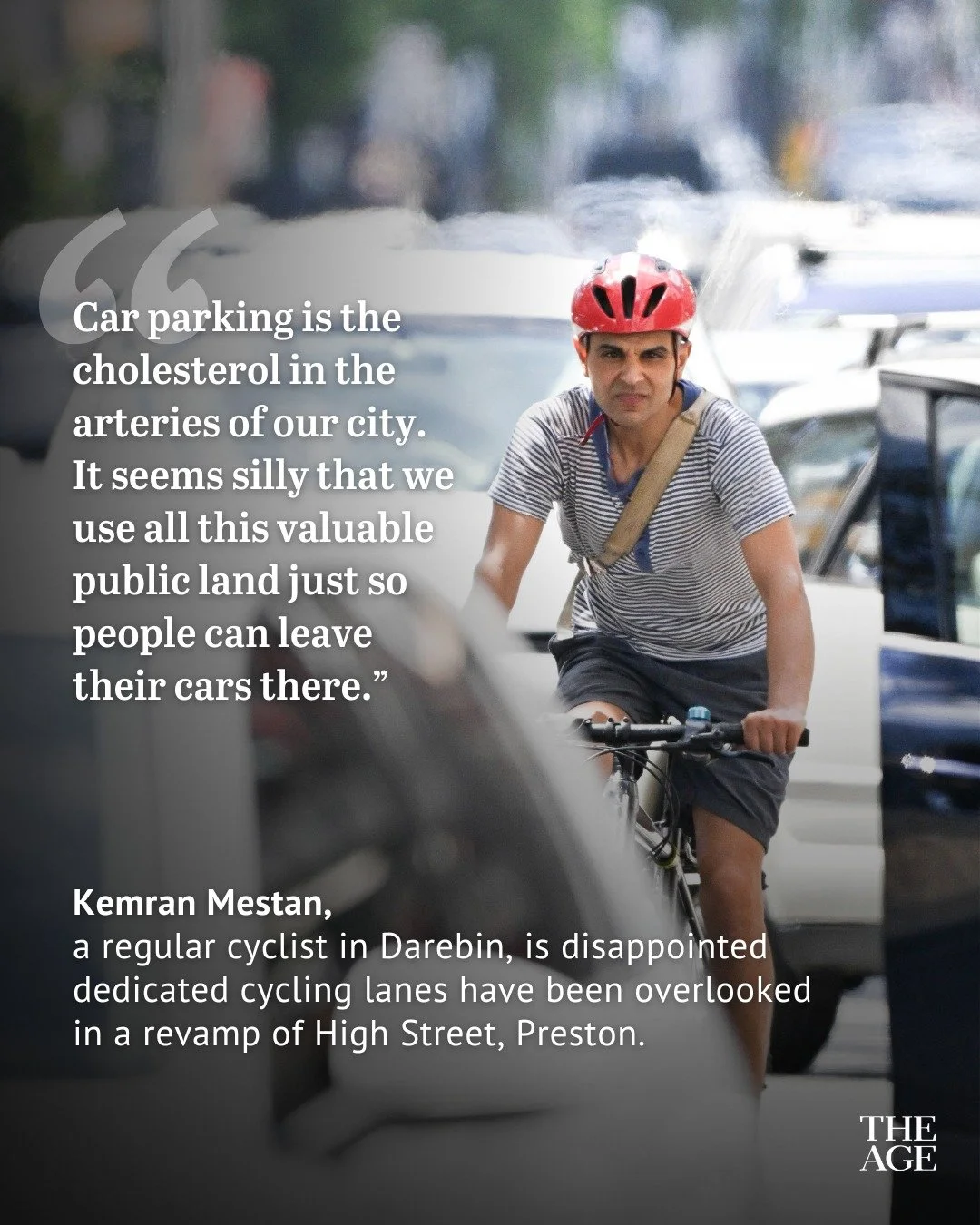
Kemran Mestan, a regular cyclist and Streets Alive Darebin member who wanted Darebin Council to add a bike lane to High Street in Preston as it undergoes an upgrade. Photo Credit: Joe Armao
Well, here is a bit of an overview of a busy year in 2025, including the good, good but do better, the bad and international good news. Read below for additional details including local news for Darebin residents:
Pop up bike lanes in Darebin made permanent,
Darebin Council prepares submission to the TAC for the installation of pedestrian crossings,
Infrastructure Victoria calls on the Victorian Government to invest in key cycling corridors - including Darebin,
Streets Alive Darebin and Critical Mass Ride to St Georges Road intersection,
Darebin Council implements 30km/hr for the first time but then goes against its own Sustainable Transport Strategy and fails to provide a separated bike lane in the Preston High Street Redevelopment,
Darebin Council cancelled the South Crescent and Victoria Road cycling project this year,
And of importance to all Darebin residents: a Report at the 15 December 2025 meeting lists the 150 active travel projects that the Darebin community has provided input on and that have been adopted but Darebin Council has not started!
The Good
Victorian Government compromises on the proposed e-bike ban on public transport after thousands of submissions from the public see: Conduct on Public Transport Regulations | Engage Victoria and for a great guide on buying an ebikes see: E-bike buying guide | Bicycle Network
Pop up bike lanes in Darebin made permanent see: Darebin – arterial routes: Heidelberg Road, Napier Street and Queens Parade intersection are expected to start in early 2026 and be completed by mid 2026.
Department of Transport and Planning allows Councils to introduce 30kms Speed limits - Transport Victoria and Infrastructure Victoria in its 30-year plan proposes widespread 30km/h per hour speed limits on local streets to improve safety and promote walking and cycling.
Crash Dash released: Australian Crash Data Map | All States & Territories | CrashDash a platform that provides filters and tools that give advocates, councils, consultants and others user-friendly access to crash data about their local areas and projects.
City of Melbourne Bike Budget reinstated after thousands of public submissions to the council's budget consultation.
The Gipps Street Ramp opens after decades of campaigning: New Gipps Street link open | Bicycle Network and here at Yarra BUG.
The new Veloway in the West opens, see: A safer, faster route for riders - Victoria’s Big Build and please complete this survey!
Darebin Council prepares submission to the TAC for the installation of pedestrian crossings across Darebin.
Infrastructure Victoria calls on the Victorian Government to invest in key cycling corridors: Victoria’s infrastructure strategy 2025–2055, to create a network of 16 priority cycling corridors. Here is a link to the technical report on cycling, and SAD website detailing route in Darebin.
Critical Mass 30th Birthday Ride and Streets Alive Darebin and Critical Mass Ride to St Georges Road intersection.
The recent $150 million allocated to active transport via the congestion levy.
Good but do better
While implementing 30km/hr for the first time Darebin Council goes against its own Sustainable Transport Strategy and fails to provide a separated bike lane in the Preston High Street Redevelopment see: Darebin sticks with bike squeeze on High Street | Bicycle Network see the Streets Alive Darebin page for more details here.
Council is to be congratulated for introducing slower speeds, more zebra crossings, more trees, more shade, more places to sit this improves the shopping strip and makes it safer and more walkable, but the big gap is the one the community highlighted from the start: cycling safety was the top concern, yet there are still no bike lanes in the final design.
Parking is being prioritised over safe cycling infrastructure. Council is willing to redesign a whole street, spend $7.5 million, remove clearways, tear up footpaths, replant trees — but it still can’t remove a line of car parking to make space for safe bike lanes. That decision undermines everything else. A 30 km/h limit is great, but the real safety gains only appear when you combine calmer speeds with proper cycling infrastructure.
Overseas, that’s when you see mode shift, retail benefits, and big drops in injuries. Doing one without the other is only half the job.
It’s 2025 — and we’re still designing streets where parking gets protected while people on bikes get squeezed into traffic or pushed onto footpaths. If you’re already rebuilding a major activity strip with a multimillion-dollar budget, that’s exactly when you fix the bike safety problem — not lock it in for another generation. We shouldn’t still be choosing car storage over safe, healthy transport options.
Victorian Government's Response to the Inquiry into the Impact of Road Safety behaviour on Vulnerable Road Users - see our March SAD Newsletter - a disappointment with no meaningful action taken by the Victorian Government.
No home for WeCycle as yet from Darebin Council
The Bad
No long-term investment by the Victorian Government in level access Tram Stops across Melbourne yet again. While we did see investment in the La Trobe Street stops the Route 57 North Melbourne Stops are being upgraded but will not be built as level access stops due to funding constraints. Nothing on the books for Route 86 noting that the stops have been designed but not funded.
Darebin Council cancelled the South Crescent and Victoria Road cycling project this year.
A Report at its 15 December 2025 meeting lists the 150 active travel projects that the Darebin community has provided input on and that have been adopted by Council, but that Council has not started. These projects include new active transport infrastructure as outcomes from numerous consultations and programs such as the Octopus Schools program, the Streets for People future bike riding infrastructure recommendations, the Northern Region Trails Strategy, Local Area Place-making engagements, and Your Street, Your Say consultations.
The Report then compares the City of Darebin’s performance when compared to other local governments for road safety. It shows that Darebin performs up to 80% worse than other councils for walking and vehicle accidents and significantly worse (100%) for cycling accidents. The Report shows the systemic underinvestment by Council in walking and cycling infrastructure in Darebin and that Council is going backwards on its own sustainable transport targets.
There will be another report to a Council Meeting by April 2026 on this matter.
Pedestrian Deaths on Victorian Roads at an all-time high: Victoria pedestrian deaths: Highest toll in 17 years sparks SUV safety concerns.
International Good News
Cycling in London reaches record levels.
London Record Cycling Surge as Daily Rides Hit 1.5 Million
The London record cycling surge is now redefining how people move around the capital. Transport for London confirms cycling in the city has hit an all time high, with 2025 seeing more people on bikes than ever. Inner London has led the way, with daily cycle journeys up nearly 15 percent in the past year alone, rising from 650,000 in 2024 to 747,000 in 2025. Across town, the sheer volume of journeys highlights the London record cycling surge, outpacing even the drop in car traffic.
City leaders attribute much of this London record cycling surge to a major expansion of bike infrastructure. Since 2020, more than 51 kilometres of protected cycle routes have been built, plus hundreds of new crossings for people walking and on bikes. In just two years, twenty four new cycleways have opened, linking another 600,000 Londoners to the ever growing network and making bike commuting practical for more areas.
Bike riding in the City of London has increased by more than 50% over the past two years, making bicycles the most common vehicle on city streets during peak hours.
The increase of more than 50% marks the largest jump since official records began in 1999. Bike riders now make up 56% of all traffic in the City – London's busiest financial district – during the peak commuting hours of 8–10am and 5–7pm.
There are also nearly twice as many bikes as cars on City streets during the day, and people walking and riding now make up three-quarters of all observed travel activity and 85% during peak hours.
Meanwhile, motor-vehicle traffic has fallen by a quarter in the five years since 2019. Air quality has also improved significantly, with just two locations across the City reaching toxic nitrogen dioxide levels, down from 15 in 2019.
What lessons might Australian cities take from the City of London's success?
These dazzling numbers can be directly linked to an increase in London's cycleways over the past decade, with the first separated cycling superhighway opened in 2015.
In 2023–2024 alone, TfL launched 20 new cycleways, connecting an additional 600,000 Londoners to the cycle network. This data aligns with traffic count data from the four road bridges into the City of London, collected by TfL in 2024.
Dockless bikes also play a huge role, now accounting for one-in-six bikes on City streets. Dockless bike riding has increased four-fold in the City since 2022.
London's Congestion Charge also helps keep motor vehicle numbers to a minimum during the day. Data shows that 40% of car and private hire journeys now occur after 6pm, when the charge finishes.
If you are interested in how London’s infrastructure is driving these changes, read more in: London’s Streets Transformed: 51km of New Cycle Routes and 400 Pedestrian Crossings Delivered in Partnership
For official information and data on cycling in London, visit Transport for London’s Cycling and Walking page.